The Patriarch: The Rise and Fall of the Bingham Dynasty
An account of the rise and collapse of the Bingham family of Kentucky chronicles three generations of a newspaper dynasty and the battles that destroyed the family.
Read Books, AudioBooks, Download Books, Ebook Pdf, Donload Ebook pdf, Audio Ebooks, Read Books Free, Free Ebooks Novel Download, AudioBooks, Download Books, Novel Ebooks, Novel Read Books, Novel Audiobooks, Romance Books, Horor Books, History Books, Advanture Books, Photography, Biography Books

An account of the rise and collapse of the Bingham family of Kentucky chronicles three generations of a newspaper dynasty and the battles that destroyed the family.

With dazzling wit and astonishing insight, Bill Bryson—the acclaimed author of The Lost Continent—brilliantly explores the remarkable history, eccentricities, resilience and sheer fun of the English language. From the first descent of the larynx into the throat (why you can talk but your dog can't), to the fine lost art of swearing, Bryson tells the fascinating, often uproarious story of an inadequate, second-rate tongue of peasants that developed into one of the world's largest growth industries.

The graduating seniors of a Seven Sisters college, trying to decide whether to pattern themselves after Katharine Hepburn or Emily Dickinson. Two young women besieged by the demands of mothers, lovers, and careers—not to mention a highly persistent telephone answering machine—as they struggle to have it all. A brilliant feminist art historian trying to keep her bearings and her sense of humor on the elevator ride from the radical sixties to the heartless eighties.
Wendy Wasserstein's characters are so funny, so many-sided, and so real that we seem to know them from their Scene One entrances, though the places they go are invariably surprising. And these three plays—Uncommon Women and Others, Isn't It Romantic, and the Pulitzer Prize-winning The Heidi Chronicles—manage to engage us heart, mind, and soul on such a deep and lasting level that they are already recognized as classics of the modern theater.

This is the story of Alaska and the Alaskans. Written with a vividness and clarity which shifts scenes frequently, and yet manages to tie the work into a rewarding whole, McPhee segues from the wilderness to life in urban Alaska to the remote bush country.

While John McPhee was working on his previous book, Rising from the Plains, he happened to walk by the engineering building at the University of Wyoming, where words etched in limestone said: "Strive on--the control of Nature is won, not given." In the morning sunlight, that central phrase--"the control of nature"--seemed to sparkle with unintended ambiguity. Bilateral, symmetrical, it could with equal speed travel in opposite directions. For some years, he had been planning a book about places in the world where people have been engaged in all-out battles with nature, about (in the words of the book itself) "any struggle against natural forces--heroic or venal, rash or well advised--when human beings conscript themselves to fight against the earth, to take what is not given, to rout the destroying enemy, to surround the base of Mt. Olympus demanding and expecting the surrender of the gods." His interest had first been sparked when he went into the Atchafalaya--the largest river swamp in North America--and had learned that virtually all of its waters were metered and rationed by a U.S. Army Corps of Engineers' project called Old River Control.
In the natural cycles of the Mississippi's deltaic plain, the time had come for the Mississippi to change course, to shift its mouth more than a hundred miles and go down the Atchafalaya, one of its distributary branches. The United States could not afford that--for New Orleans, Baton Rouge, and all the industries that lie between would be cut off from river commerce with the rest of the nation. At a place called Old River, the Corps therefore had built a great fortress--part dam, part valve--to restrain the flow of the Atchafalaya and compel the Mississippi to stay where it is.
In Iceland, in 1973, an island split open without warning and huge volumes of lava began moving in the direction of a harbor scarcely half a mile away. It was not only Iceland's premier fishing port (accounting for a large percentage of Iceland's export economy) but it was also the only harbor along the nation's southern coast. As the lava threatened to fill the harbor and wipe it out, a physicist named Thorbjorn Sigurgeirsson suggested a way to fight against the flowing red rock--initiating an all-out endeavor unique in human history. On the big island of Hawaii, one of the world's two must eruptive hot spots, people are not unmindful of the Icelandic example. McPhee went to Hawaii to talk with them and to walk beside the edges of a molten lake and incandescent r

Rebecca Mandeville
The story of The Changeling is told by Angelet's daughter, Rebecca, who was born in Benedict Lansdon's grandfather's house in an Australian gold-mining township. Before Rebecca was born, her father had died saving another man's life. She had always looked up to him as a great hero and when she heard that her mother was to marry Benedict Lansdon, she was deeply shocked.
The prolific British author of historical romances (The Pool of St. Branok) continues her lavishly entwined narrative of the families connected to Benedict Lansdon, now a recently bereaved widower, absentee father and wealthy seeker of a Parliament seat. Narrated by Benedict's aggrieved stepdaughter, Rebecca, this complex tale of love and betrayal concerns a three-cornered sibling relationship involving Rebecca, her half-sister, Belinda, and Lucie, a country waif informally adopted by Rebecca. Aware that her father blames her for her mother's death in childbirth, Belinda takes refuge in michievous behavior. Placid Lucie, however, fits in well with the family, though her lineage is suspect and clouded with mysterious events at St. Branok's pool. Although Belinda seems the most obvious "changeling", Carr sustains an air of doubt and intrigue. The ambience of the Cornish countryside and of Victorian London permeate this piquantly Gothic family saga.

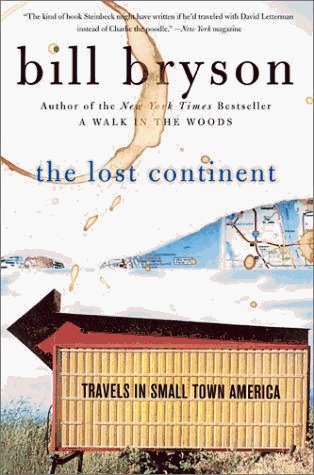
'I come from Des Moines. Somebody had to'
And, as soon as Bill Bryson was old enough, he left. Des Moines couldn't hold him, but it did lure him back. After ten years in England, he returned to the land of his youth, and drove almost 14,000 miles in search of a mythical small town called Amalgam, the kind of trim and sunny place where the films of his youth were set. Instead, his search led him to Anywhere, USA; a lookalike strip of gas stations, motels and hamburger outlets populated by lookalike people with a penchant for synthetic fibres. Travelling around thirty-eight of the lower states - united only in their mind-numbingly dreary uniformity - he discovered a continent that was doubly lost; lost to itself because blighted by greed, pollution, mobile homes and television; lost to him because he had become a stranger in his own land.
The Lost Continent is a classic of travel literature - hilariously, stomach-achingly funny, yet tinged with heartache - and the book that first staked Bill Bryson's claim as the most beloved writer of his generation.